DESIRING HAPPINESS

We all desire happiness. Some by gaining material possessions, others by socializing, some by doing activities alone. However, over a period of time all these change, lose meaning and search for happiness starts again. Basis for happiness is not collecting baggages (material or emotional). Then what gives us happiness? It varies with each person but we all in common desire happiness.

To achieve happiness one needs to be in constant search by self-enquiry & facing life as it unfolds, be willing to change & be open to recieve unexpected life happenings on this journey. Then happiness discovers you or rather you discuss happiness.

Argument or Discussion

Argument is when you want to prove your opinion or point at the cost of winning over the situation/person you are arguing with. However, discussion is more of an openness towards considering the other persons opinion as a possibility in spite of it being contrary to your opinion. Arguments may end up in fights, where as a discussion helps us to be more open,tolerant and indicates respect for others opinion. Discussion gives openness towards a healthy relation and willingness to change your opinion based on reasoning.

Another important point is that discussion helps to develop mutual respect whereas an argument often leads to trying to put down or degrade the other person or their opinion.

Wishing you many more healthy discussions!

Home with young children

Environment at home, when there are young children, needs flexibility, repeatability and predictability and emotional calmness. This helps young children grow securely with happiness. It is essential to be flexible in your routine, however, regularity of sleep, timings of eating habits, and repetition of actions such as responding with smiles, look of appreciation at person when impressed, are desirable behaviours.

Too much disorganization of home in terms of odd or changing timings for daily routines of adult members and high noise levels (arguments) will confuse children and can form basis for anxiety, insecurity & uncertainty

Willingness to change, a healthy factor in emotional bonding

In an emotional relation (between 2 persons), the suffering person has more need to get relief from hurt and hence will be open towards change. However, change in a relation needs to happen for both sides. For long term healthy relational growth, change in a relation is a basic growth point. If only one is willing to change or both are resistant to change, the relationship stagnates to the extent of rigidity or pulling back from relating further to the person.

Especially in long term relations like couples, siblings, the effects can be damaging for a lifetime. Be open to change & live a worthy relation than stagnate & waste precious life.

HAPPY CHANGING!

Pain is a healer

When you love someone a lot, you do not want to hurt them. Good principle, but a meaningful relationship is not possible if pain is not shared or understood. In fact, a problem or trouble in a relation can be a perfect ground for better growth/bonding depending on how quickly you resolve that problem. If a difficulty or problem is tucked safely without addressing it by acts such as avoiding to talk about it, blaming the situation or acting as if everything is going on fine, that will only be a short term solution. Troubles in a relation always accumulate and have cumulative effect hurting the relationship the most. Instead, look at the problem or trouble in a relationship as growth point to bond better. If this is done, pain is always a healer. Happy Suffering

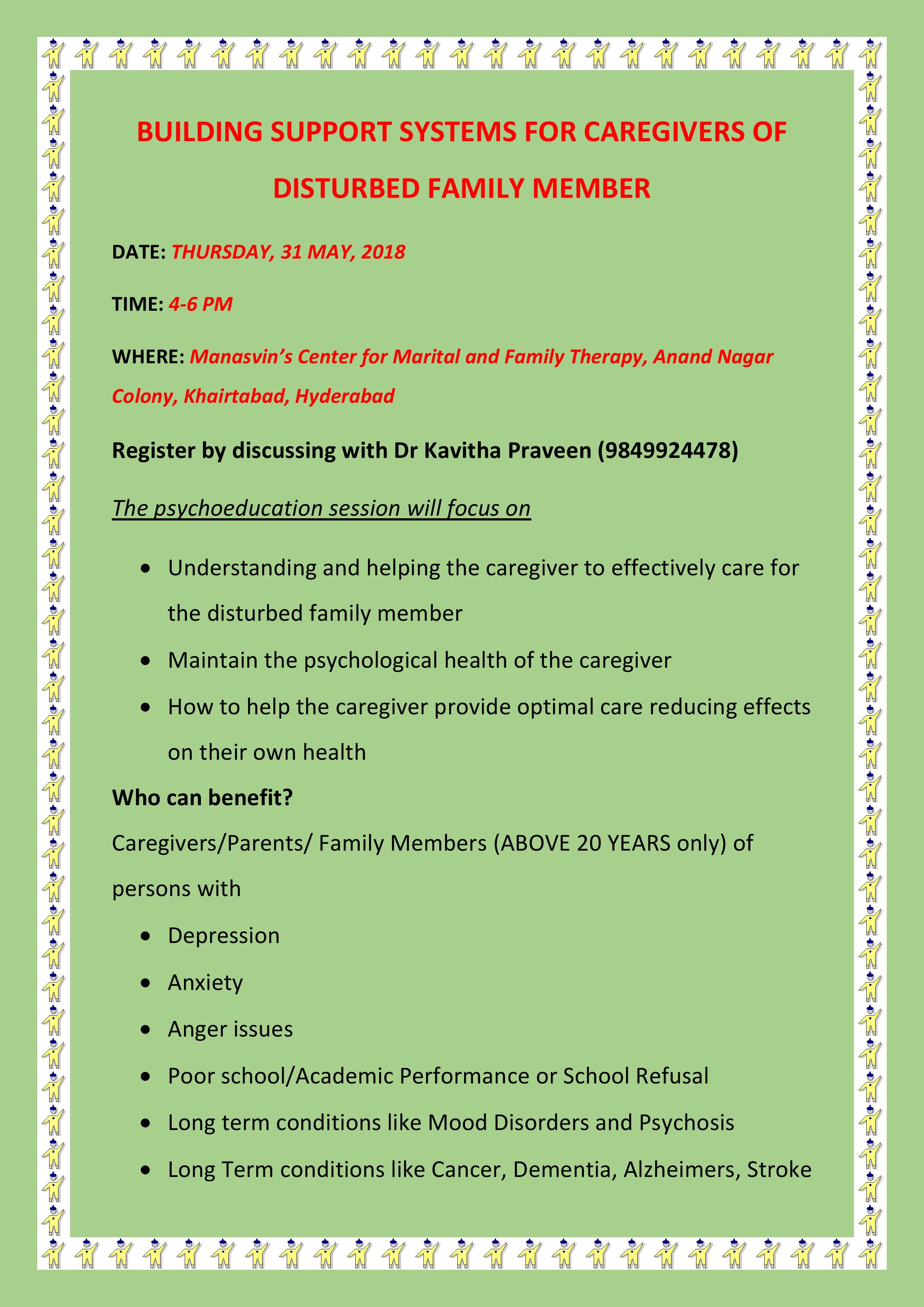
Building Support Systems for Family Members of Persons with Depression-Workshop

A Video of a workshop conducted by Dr Kavitha on May 31, 2018. The Workshop focused on encouraging family members of persons with depression to understand more about the condition, build support systems and ensure caretakers do not neglect their own health.

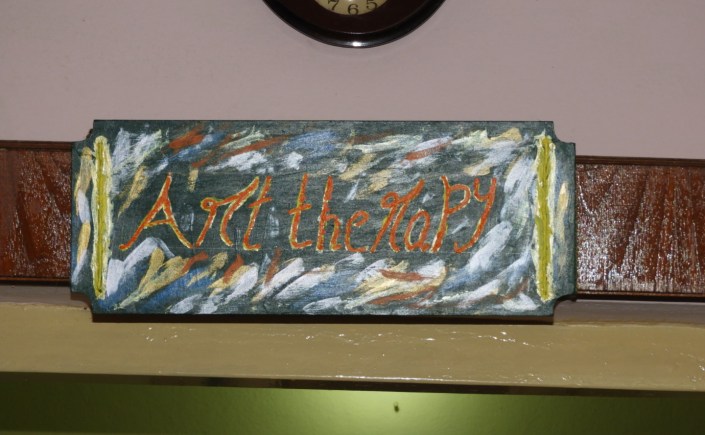
Role of Art & Art Therapy

Role of Art & Art Therapy in the Holistic Development of Children and Psychological Healing of Clients with Emotional Issues

A brief descriptive summary of the Workshop on Art Therapy held on April 14, 2018

Art, Art classes, Painting sessions, Summer Art Classes! What are they all about? How do they help or benefit the growth and development of children at all ages?

Art can help children improve their communication skills, their social interaction and emotional and physical development.

Are art classes different from Art Therapy? Who can benefit from Art Therapy?  What activities are involved in Art Therapy?

Art Therapy is the deliberate use of art to address psychological and emotional needs. Art Therapy uses the media of art and the creative process to help in areas such as, but not limited to, fostering self-expression, creating coping skills, managing stress and strengthening a sense of self.

Art includes visual (like painting) and expressive arts (like music, clay work, poetry, dance, sand therapy and drama/theatre). Art is different from Art Therapy. Art Therapy involves the use of art for psychological counselling to treat developmental (mental or intellectual limitations), medical conditions (cancer, dementia), and resolution of unexpressed emotional conflicts. Art Therapy can also be used to manage troubled behaviors (Attention Deficit Hyperactive Disorder, self-injurious behaviors, anger issues in children), building interpersonal skills (socially shy, introvert temperament), regulating emotions in stressful situations (occupational, academic, career related areas) and to achieve insight of more troubled emotions (in abuse, loss of loved on, failure etc)

Art Therapy has several benefits.

Some of these may be physical like building strength in arms, hands and fingers (in young babies/toddlers, in those with weak hand or limb muscles) by activities like holding crayons, paint brushes, pencils.

Art Therapy also helps in sensory exploration, as a fun filled, pressure free, pleasurable activity of creating things that are colorful.

Art Therapy also helps in improving eye-hand and motor co-ordination.

For preschoolers, the creation of art maybe a big accomplishment as they enjoy the process of involving in art by representing real or imagined objects. This helps them develop their thinking process and imagination.

For school going children, Art may help in preparation or further improvement of writing skills and better motor control of the finger grasp. These children can also develop a sense of sharing, responsibility, social skills development and social interactions as they work in groups. Art also helps improve observation skills necessary for life and academics, helps them to interact or be more sensitive to nature and the surrounding environment. Art also helps them share their experiences, express or verbalize their feelings and helps them improve their self-esteem.

Art Therapy can include activities like painting, drawing, sketching, doodling or visual arts. Art Therapy can also include activities of movement or expression like music, dance, drama, role plays, and sand therapy.

Art Therapy facilitates positive change by involving in the creation of something- productivity as an achievement in depression. Art Therapy can also be used as a distraction in obsessive compulsive behaviors shifting the focus away from the obsessive compulsive behavior.

Art Therapy can also help with the ventilation of emotions that are difficult to express using words especially in conditions of anxiety, abuse, or anger/acting out in children as well as in adults.

Art Therapy thus allows an individual to get in touch with their feelings that they find difficult to express otherwise.

Art Therapy modifies the physiology and structure of the brain and leads to a more flexible, adaptable individual. The therapy works with multiple senses (vision, touch, smell, hearing) in addition to muscle movements and social interactions with others. Art Therapy can thus help to heal an individual mentally, emotionally, and physically while they build skills to cope with the pressures of life.

At our center, Manasvin’s Center for Marital and Family Therapy, we use art therapy effectively as a psychological healing method.

We have an artist (trained from Shantiniketan) who works individually and through group sessions. Art Therapy sessions are customized to the needs of each client based on inputs from a trained clinical psychologist and includes visual arts (painting, drawing, sketching) and expressive arts like Music Therapy (Guitar, Flute), Work with Clay, Sand Therapy, Role Plays, Poetry and Story writing and telling sessions.  
 

Can a close/trusting emotional relationship damage the trusted person?

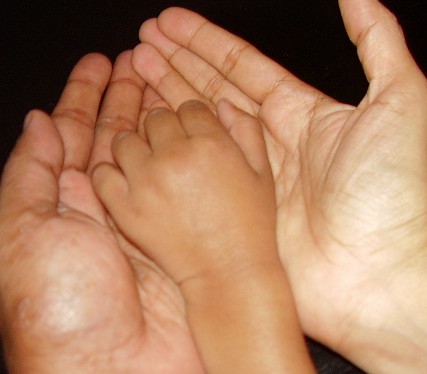
Can a trusted person be damaged by a close or trusting emotional relationship? Sounds illogical but it is possible. Deeper emotional dependence is often considered unhealthy but is an inborn tendency of humans. It is not necessarily a childhood characteristics that we need to outgrow.

Secure dependency is a sign of a healthy relationship, which helps one to be confident and independent in functioning. The more secure we are, the more independent we can be, rather, interdependent and self sufficient we can be. The availability of a emotionally close person provides comfort and security and their lack of access or unavailability can be distressing or hurting. Closeness with an emotionally unaffected person can reduce anxiety and help healthy unfolding of one’s personality. It gives confidence to take risks, learn new information, deal with problems and manage stress effectively in life.

Accessibility and emotional responsiveness are core of healthy bonding between individuals that help build trusting relationships. Our strongest of emotions arise in attachment/emotional relationships.

Insecure emotional relationships can be extremely distressing with anger and aggression experienced on loved ones. Requests for attention and reassurance from emotionally close friends or persons and their failure to respond can lead to anger outbursts, depression leading to detachment over a period of time. Depression maybe a natural response to lost emotional connections. This kind of response or reaction patterns can happen with any relation such as a parent and a child, siblings, wife and husband etc.

Maternal deprivation where an attachment figure is unavailable by rejection or abandonment or loss can be traumatic in the sense of ones ability to deal with fear and stress in one’s life. Unavailable emotional relationships can create insecure attachment with oneself and one’s world leading to inability to handle stress and their ability to emotionally relate to their loved ones.

On the other hand, a close or emotionally attached person can become manipulative or use ones closeness for their selfish needs of material or emotional gains which in the long run can be more damaging to the affected person than helping him or her to deal with the stress. An over-involved parental figure in child activities such as not letting child explore one’s world for fear of hurt or rejection can be damaging to the child in the short and long term as an adult.

In conditions like schizophrenia, it is a well established fact that over involvement, being very critical of ones behavior by an attachment figure or parental figure can be continuous stressors for the symptoms to reappear over a period of ones life time. Rather, these critical behaviors and over involvement can maintain ones psychological disturbance. Non availability of emotionally close relationship can lead to depression which can be limited to oneself or even run in families projecting relational  patterns in a family relationship with repeated cycles over generations.

The extreme form of malfunctioning can happen with unhealthy personalities, where ones close and emotionally related persons, manipulate emotions to the core leaving the attached person hurt and blunt by the distancing over a period of time. Here, such persons can use emotions and emotionally close persons as instruments of meeting their needs, using them as objects than emotional beings, even without their knowledge. In other words, the quality of manipulating one’s loved ones can itself become their natural personality tendency leading to more and more loss of loved ones over a period of their life time and possibly leading to isolation, denial and ultimately lost relationships.

Emotions and emotional relationships are complex and one needs to invest time and energy to analyze and retrospect in order to live and healthy and secure relationships. If one does not make the effort to invest time and energy into the relationship, one can be left depressed, isolated, and even ill.